
What’s new in Dynatrace SaaS version 1.343
Dynatrace SaaS 1.343 introduces centralized "Fleet Management" for scaling the management of OneAgent and ActiveGate components, alongside enhanced update controls and more secure …
Dynatrace SaaS 1.343 introduces centralized "Fleet Management" for scaling the management of OneAgent and ActiveGate components, alongside enhanced update controls and more secure …
Dynatrace is pursuing FedRAMP Class D (High) certification to expand upon its existing FedRAMP Moderate authorization, aiming to support federal agencies managing highly sensitive,…

This article outlines recent Dynatrace updates, highlighting a new unified topology view in Smartscape and enhanced AI observability through tools like `dt-evals` for LLM evaluatio…

To navigate the overwhelming hype surrounding new AI coding tools, developers should focus on identifying creators who demonstrate real value through public work and shared impleme…

The Dynatrace Managed 1.342 release introduces new availability metrics that exclude maintenance windows, enhanced Data Explorer query capabilities, and selectable text in dashboar…
Dynatrace provides full-stack observability for complex agentic AI systems by monitoring everything from GPU infrastructure and model performance to token consumption. Through its …

Dynatrace has enhanced its Kubernetes Security Posture Management (KSPM) by embedding vulnerabilities, threats, and misconfigurations directly into its existing Kubernetes app to e…

The Dynatrace OneAgent 1.341 release introduces 30 new features, focusing on expanded application observability for technologies such as the Azure SDK for Java, Python Azure Functi…
Dynatrace SaaS version 1.342 introduces enhanced Kubernetes observability through integrated log insights and expanded AI observability via OpenInference instrumentation support. T…
Dynatrace has expanded its HIPAA-compliant observability services to include Google Cloud Platform (GCP), allowing healthcare organizations to standardize security and monitoring a…
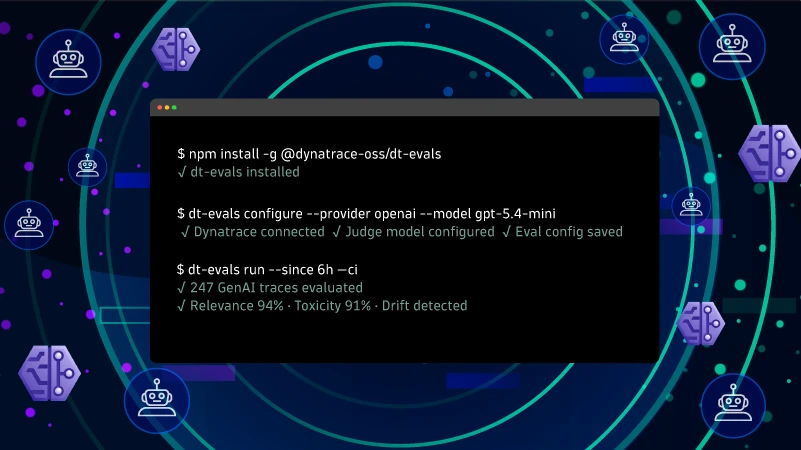
This article explores how LLM evaluations provide a systematic framework for measuring the quality, accuracy, and safety of probabilistic AI models as they move from experimentatio…
To support the scale and complexity of AI workloads, teams must transition from traditional, fragmented log management to a unified observability platform that integrates logs, met…